Published: 10:34 AM, 29 September 2025
Condensate Theft at Chevron Pipeline: Who’s Involved?
Sangram Datta
For years, in Sreemangal and across the Sylhet division, an organized influential quarter has been stealing condensate by illegally tapping pipelines, including those on the Sylhet–Ashuganj route. Media reports say in the past have exposed these incidents and cases have even been filed with some arrests made. It's alleged that influential leaders of different political parties, local elites, and even a few so-called journalists were involved in this network.
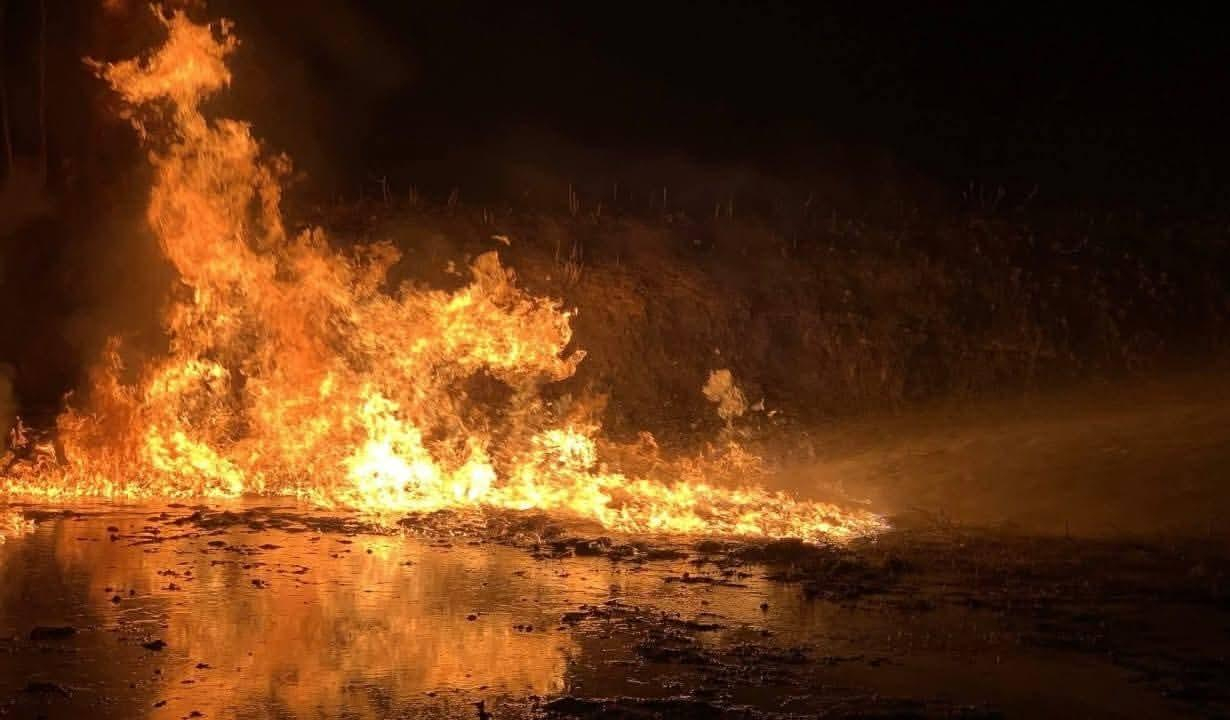
Recently, at Shason Ilampur village of Bhunabir Union under Sreemangal upazila in Moulvibazar district, miscreants attempted illegal tapping on a pipeline belonging to multinational company Chevron Bangladesh Ltd. During the attempt, condensate leaked from the punctured pipeline leading to a devastating fire. The leaked condensate mixed with the waters of the local Jaitacherra stream ( A small river). When members of a local family went to collect the fish that floated up, they were suddenly engulfed in flames.
All three members of the family sustained severe burns. They were initially taken to Sreemangal and Moulvibazar hospitals, then transferred to Sylhet MAG Osmani Medical College Hospital and later to Dhaka’s National Institute of Burn and Plastic Surgery. Tragically, within just 48 hours, the father and son succumed to their injuries. The mother remains in the ICU fighting for her life.
Full account of the incident:
On 23 September 2025, three members of a family from Shason Ilampur village at Bhunabir Union in Sreemangal upazilla were burnt when condensate leaked from a Chevron pipeline that had been illegally tapped.
On 27 September 2025, at dawn, Bashir Mia (50) and his son Redwan Mia (20) succumbed to their injuries while undergoing treatment at the National Institute of Burn and Plastic Surgery in Dhaka. The only surviving member of the family, Bashir’s wife Farzana Akter Parvin, is still battling for life in the ICU.
This tragedy is not merely a personal loss; it is a stark reminder of the country’s fragile energy security, corporate negligence and administrative failure.
Questions of safety:
How could the pipeline of a multinational company like Chevron be punctured so easily? Why was it not detected earlier? How effective was the monitoring system of the pipeline? Experts warn that condensate is highly flammable and even a minor leak can bring a disaster.
Bangla Tribune reported on 27 September 2025, a Chevron employee on condition of anonymity quoted “The miscreants drilled a hole into a 12-inch pipeline to extract condensate. Later, the hole could not be sealed. This line carries high pressure, so the perpetrators fled the scene after failing to close it.”
Company’s response:
Chevron Bangladesh’s Media and Communications Manager Sheikh Zahidur Rahman told reporters that“Miscreants punctured the pipeline in an attempt to steal condensate. This led to a spill, which caused the fire. We have taken responsibility for the victims’ medical treatment.”
However, local residents demand not just medical support but also long-term compensation and rehabilitation for the affected family.
Local journalists’ investigation and comments:
Syed Abu Zafar Salauddin, local correspondent of Daily Jugantor posted on his verified Facebook account stating “According to reliable sources, the long-standing Ashuganj-centered oil theft syndicate is behind this incident, involving local journalists, sand traders, political leaders, and even Chevron security guards. If the administration fails to act, law enforcement will have to bear responsibility for the deaths of innocent people.”
Rubel Ahmed, local correspondent of Daily Dinkal, also posted and said that “In Sreemangal, a father and son have died in a fire caused by miscreants puncturing Chevron’s pipeline. According to confidential sources, a syndicate of local journalists, sand traders, and political leaders has been stealing oil for long and selling it in Ashuganj, Brahmanbaria. Yet, even after such a major incident, law enforcing agencies shows little activity.”
Moulvibazar district correspondent Md. Saiful Islam of Bangla Tribune reported that “A group in this area has long been puncturing pipelines to steal crude condensate. This time, condensate leaked uncontrollably, spread into water and later caught fire.”
A recurring crime: lessons from history:
The key questions remain that who is responsible for this terrible disaster? Who are involved in the illegal tapping?
This is not the first such incident. For two decades, the Sylhet–Ashuganj condensate pipeline has repeatedly been punctured for theft.
On 3 March 2012, United News 24 reported that miscreants drilled a pipeline in Rajnagar, Moulvibazar on February 29, 2012 and stole hundreds of liters of condensate.
The same report noted that, up to that point, the 175-kilometer Sylhet–Ashuganj pipeline had been punctured at least 73 times.
Between 2001 and 2012, at least 16 condensate theft incidents were recorded in Moulvibazar alone. Some resulted in fires and loss of lives. Cases were filed, but no permanent solutions were achieved.
Experts’ views
Energy experts emphasize:
Condensate is extremely flammable, even a small leak poses major disaster risks.
Without advanced monitoring systems (SCADA, leak detection sensors, pressure control systems) pipelines cannot be kept safe.
Beyond corporate measures, state-level vigilance, strict law enforcement and local community engagement are essential.
Role of administration:
The Sreemangal Upazila Nirbahi Officer (UNO) Md. Islam Uddin confirmed to the local newsmen that the family is receiving assistance. But experts insist that administration’s role can't end with temporary aid, it must extend to long-term safety measures and decisive action against condensate theft.
The way forward:
Prompt and transparent investigation: A full forensic inquiry to identify culprits and ensure justice.
Compensation and rehabilitation: Fair compensation and long-term support for the victims’ family.
Technology upgrade: Real-time monitoring systems and automatic safety valves on pipelines.
Strict surveillance: Regular patrols by law enforcement and intelligence agencies, plus a community-based reporting system.
Corporate accountability: Chevron’s responsibility goes beyond medical support; it must strengthen safety planning and deliver on it's social responsibility (CSR).
Conclusion:
The Sreemangal pipeline tragedy wiped out an entire family’s future, but more than that, it revealed the fragility of Bangladesh’s pipeline security and the unchecked power of illegal tapping syndicates. Without urgent and decisive measures, similar disasters will happen again.
Pipelines do not merely transport fuel; they carry the lifeblood of the economy and the safety of communities. Protecting them is now a shared responsibility of the state, corporations and society at large.