Published: 06:16 AM, 26 November 2025
The Country’s Laws Are Not Journalist-Friendly; Whoever Comes to Power ‘Harbors a Mindset of Control’
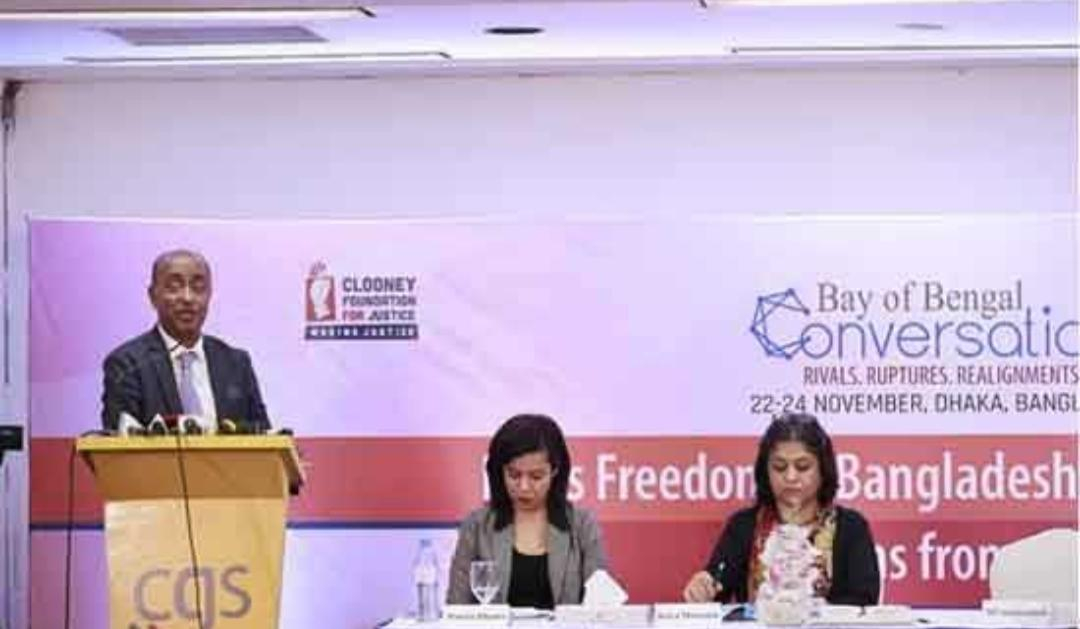
Sangram Datta: Over the past year, the trend of indiscriminate arrests of journalists in the country has decreased. However, journalists are still being detained under the Anti-Terrorism Act. Regardless of who comes to state power, they tend to nurture a mindset of controlling and restraining journalists. The obstacles to free flow of information are not limited to the Digital Security Act (DSA) or the Cyber Security Act (CSA); the broader challenge lies within the overall freedom of expression.
These observations came up on Monday ( 24 November 2025) in a discussion held in Dhaka.
It was also noted that the existing laws related to the media and journalism in Bangladesh are not journalist-friendly, and the Press Council is not functioning adequately to protect journalists’ interests.
The Center for Governance Studies (CGS) organized the three-day conference titled “Bay of Bengal Conversation 2025” at a hotel in Dhaka. The closing day’s session focused on:
“Publishing Reports Related to the Digital Security Act: Key Lessons for the Future of Media Freedom in Bangladesh.”
Speakers included the Attorney General of Bangladesh, Md. Asaduzzaman; senior Supreme Court lawyer Sara Hossain; and Dhaka University Professor of Peace and Conflict Studies, Sajjad Siddiqui.
Report Publication
CGS and the Clooney Foundation for Justice jointly published a research report analyzing how the Digital Security Act (DSA) affected media freedom in Bangladesh and what lessons the country can draw from the experience.
The report analyzed 222 cases involving 396 journalists, demonstrating how DSA was used to criminalize journalism and criticism. Additionally, interviews were conducted with 30 journalists to directly assess the Act’s implementation and impact.
‘As Many Laws as Stars in the Sky’
Speaking at the conference, Attorney General Md. Asaduzzaman said, “The state has kept open numerous ways to suppress journalists. It is often said: as many stars as there are in the sky, there are that many legal clauses. All such clauses are applied to restrain and control journalists.”
Referring to repressive laws from the British colonial era to post-independence Bangladesh, he added, “Whoever comes to state power harbors a mindset of suppressing journalists.”
He stated that the Digital Security Act introduced by the previous Awami League government—after repealing Section 57 of the ICT Act and allegedly after broad consultations—was in fact a deception.
Highlighting various examples of misuse of such laws in the past, the Attorney General said, “We want an end to all these repressive and oppressive laws—laws that silence voices and stop journalists’ pens. Those who will lead the country politically in the coming days must rethink these issues so that such laws never return.”
Merely abolishing the Digital Security Act will not be enough, he argued:
“To change this trend, the mindset of the state itself must change.”
Citing a case involving a teenage girl in Dinajpur, he insisted that legal reform alone cannot solve the problem.
He also expressed hope for a culture free from fear:
“Since the current government took office, no enforced disappearances have occurred, and extrajudicial killings have significantly declined. In the past 17 months, not a single ‘fictitious’ case has been filed by the police on their own initiative.”
He expressed confidence that the next elected government would move away from all forms of repressive legislation.
Indiscriminate Arrests
Senior Supreme Court lawyer Sara Hossain said that over the past year, indiscriminate arrests of journalists have decreased—an encouraging development. However, she emphasized the need to scrutinize the role of the courts:
“Police lacked accountability. Likewise, it is important to assess how independent the judiciary truly was.”
She noted that journalists are still being detained under the Anti-Terrorism Act, adding:
“The problem is not just DSA or CSA; the problem lies in the broader crisis of freedom of expression.”
She observed that older laws are being used in new ways to target journalists, and that mob pressure is increasingly influencing legal processes:
“Mob pressure is now often steering cases away from the legal course.”
She also expressed concern that magistrates are taking up cases without government approval, and police are acting in similar fashion.
Press Council
Sara Hossain remarked that the Press Council is not functioning properly. She welcomed the recent recommendations from the Media Commission and stressed the need for activating human rights and information commissions so that disputes can be resolved outside the courts.
“Cases against journalists were never intended to be taken to full trial. They were filed to silence speech and shut down writing.”
She acknowledged progress—such as the Supreme Court’s guidelines on arrest without warrant now being incorporated into the CrPC—but said implementation remains weak.
Other speakers included Maneka Khanna, Senior Program Manager of TrialWatch, in a session moderated by CGS Research Associate Roman Uddin.
Harassment and Intimidation
According to the CGS report, the ruling authorities turned the Digital Security Act into a tool for harassing and intimidating journalists. Politicians (73 cases out of 222) and other influential individuals used the Act to pursue personal vendettas or abuse power. Many journalists were arrested without warrants.
The law allowed anyone to file a complaint, regardless of whether they were the actual victim. As a result, some journalists faced multiple cases for the same report.
One case example: after a news report exposing police corruption, the implicated officer did not file a complaint—but a ruling party activist did. The journalist later alleged that during interrogation, 5–6 officers questioned him aggressively, subjected him to electric shocks, and focused heavily on whether he held “anti-government” views.