Published: 07:05 AM, 09 February 2026
Minorities Reduced to Second-Class Citizens: Prof. Robeayet Ferdous
Sangram Datta, Dhaka, 8 February 2026: Concerns over the safety, rights, and political participation of Bangladesh’s religious and ethnic minorities have resurfaced following fresh allegations that the country’s interim government has effectively relegated these communities to the status of "second-class citizens."
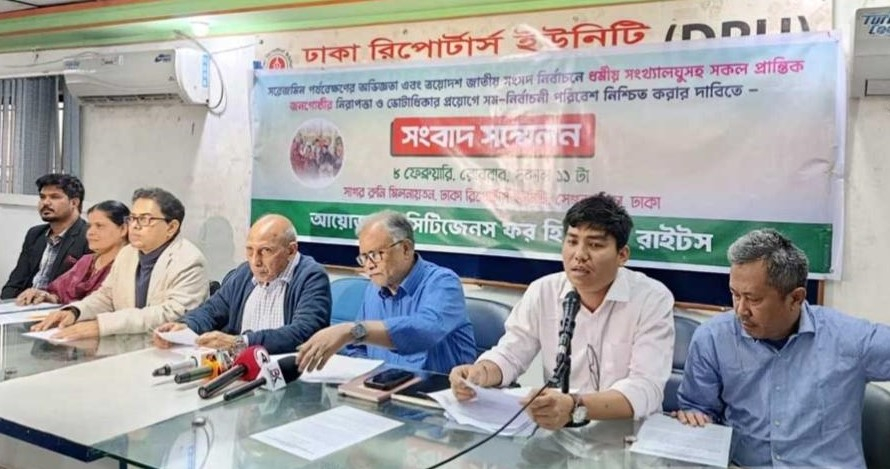
The remarks came from Professor Robeayet Ferdous of Dhaka University’s Mass Communication and Journalism Department during a press conference at the Sagar-Runi auditorium of the Dhaka Reporters Unity in Bangladesh on Sunday (8 February).
The event was organized by the rights-based platform Citizens of Human Rights after representatives visited minority households recently burned at Rauzan and Mirsharai of Chattogram in Bangladesh.
Ferdous argued that, despite Islam being the state religion, adherents of other faiths have not been able to practice their religions peacefully over the past 18 months. He described what he termed a deepening structural marginalization of Hindu, Buddhist, and Christian communities, saying the interim administration’s record has resulted in their effective and lasting exclusion from equal citizenship.
The professor linked these concerns to a series of arson attacks in which at least 19 homes belonging to Sanatan (Hindu) families were set ablaze. According to information presented at the press conference, the houses were allegedly locked from the outside at night before being burned—an act speakers characterized as intended to create panic rather than theft.
Framing the incidents within the broader political climate ahead of elections, Ferdous suggested that fear could discourage minority voters from going to polling stations. At the same time, he warned of a contradictory political narrative in which non-participation might later be portrayed as partisan boycotting, leaving minorities vulnerable to blame from competing political actors. He described this predicament as a “double paradox” in which even exercising the right to vote does not guarantee personal safety or security at home afterward.
Beyond individual incidents, Ferdous pointed to what he called systemic weaknesses in law enforcement, governance, and administrative integrity, arguing that corruption and influence-seeking practices have intensified insecurity among marginalized populations. When state institutions appear distant from vulnerable citizens, he said, communities are left with little recourse beyond moral or spiritual appeals for justice.
In a written statement, Zakir Hossain, chief executive of Citizens of Human Rights, elaborated on the Chattogram attacks, asserting that the nature of the fires suggested an intention to cause maximum harm to residents. He reported that affected communities are now maintaining night-time watch rotations and installing CCTV surveillance to guard against further violence.
Hossain further argued that pre-election violence against minorities often serves a strategic purpose: spreading fear to discourage electoral participation and thereby undermining equal democratic rights.
On behalf of the organization, he presented five key demands:
Clear and effective directives to law-enforcement agencies to ensure voter security in minority-populated constituencies, alongside the creation of a high-level central monitoring mechanism;
Comprehensive investigations into all incidents of violence against minorities, with swift arrests and legal action against perpetrators;
Adequate compensation and rehabilitation for affected families;
Measures to address the psychological trauma experienced by victims;
Active priority oversight by the National Human Rights Commission.
The organization also called on all election-oriented political parties to assume a constructive and protective role in safeguarding minorities’ voting rights and ensuring their security both during and after the electoral process.
The developments highlight a recurring and sensitive issue within Bangladesh’s democratic landscape: the intersection of minority protection, electoral integrity, and state accountability. As political momentum builds toward future elections, the response of authorities and stakeholders to these allegations may prove critical in shaping public confidence—particularly among communities that already feel vulnerable at the margins of national life.