Published: 11:21 AM, 02 April 2026
Indonesia’s Living Pluralism: A Giant Statue and a Deeper Story
Sangram Datta
Indonesia, the world’s largest Muslim-majority nation, often defies simplistic narratives. With roughly 87 percent of its population identifying as Muslim, the country is frequently viewed through a singular religious lens. Yet its civilizational identity tells a far more layered story—one shaped by centuries of Hindu-Buddhist influence that continues to echo across its culture, art, and national imagination.
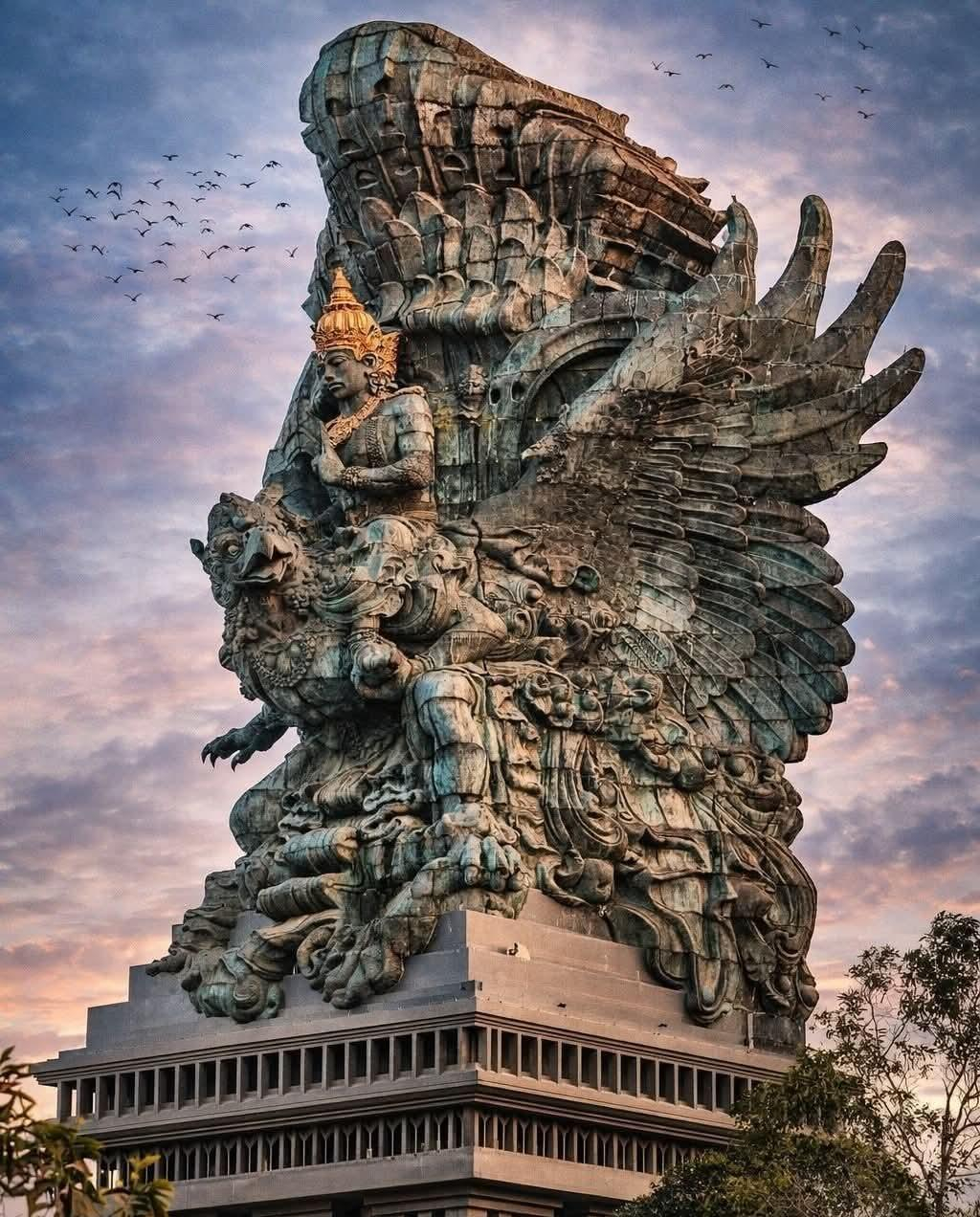
Few symbols capture this complexity more vividly than the Garuda Vishnu Kencana (GWK) statue in Bali. Towering at 121 meters (397 feet), the monument is not merely an architectural feat; it is a statement about Indonesia’s enduring pluralism. Located within the Garuda Vishnu Kencana Cultural Park and designed by renowned sculptor Nyoman Nuarta, the statue stands as one of the tallest in the world, surpassing the Statue of Liberty in height by approximately 30 meters.
But comparisons of scale alone miss the point. Unlike the slender verticality of the Statue of Liberty, the GWK statue is expansive and grounded, with a wingspan of 64 meters that gives it a commanding horizontal presence. It depicts Garuda, the mythical bird-like creature, serving as the mount of Lord Vishnu—an image deeply rooted in Hindu cosmology. The narrative behind it draws from the ancient myth of Garuda’s quest for Amrita, the nectar of immortality, undertaken to liberate his enslaved mother. In exchange for the nectar, Garuda agrees to serve Vishnu, embodying themes of sacrifice, devotion, and liberation.
That such a monument rises in modern Indonesia is not incidental. It reflects a national identity that has long accommodated diverse religious and cultural currents. Before the arrival of Islam, the Indonesian archipelago was home to powerful Hindu-Buddhist kingdoms such as Majapahit and Srivijaya. Their legacies remain etched not only in historical texts but also in the country’s architecture, language, and symbolism. Even Indonesia’s national emblem, Garuda Pancasila, draws directly from this shared heritage.
Bali, where the GWK statue stands, is itself a living testament to this continuity. As a Hindu-majority island within a predominantly Muslim nation, it demonstrates how religious diversity can coexist within a unified national framework. Daily rituals, temple festivals, and artistic traditions in Bali preserve a worldview that predates Islam, yet remains fully integrated into Indonesia’s modern identity.
The completion of the GWK statue on July 31, 2018, and its official inauguration on September 22 of the same year by President Joko Widodo, marked more than the unveiling of a monumental sculpture. It signaled Indonesia’s willingness to celebrate its pre-Islamic past without contradiction or hesitation. In an era when identity politics often sharpens divisions, Indonesia offers a quieter, more nuanced model—one where history is layered rather than erased.
For international observers, the lesson is clear. Nations are rarely defined by a single narrative, and attempts to reduce them to one often obscure more than they reveal. Indonesia’s example suggests that cultural inheritance is not a zero-sum equation; it is an evolving mosaic.
The Garuda Vishnu Kencana statue, then, is more than a tourist attraction. It is a towering reminder that identity can be expansive, that history can be inclusive, and that even in a rapidly changing world, the past continues to shape the present in profound and visible ways.